Best flat roofing materials – Flat roofs compared
What is the best flat roof, or roof material for flat roof replacement? This is a question I get asked a lot, and to be honest there isn’t a right or wrong answer – But there is sometimes a type of flat roof that would suit a flat roof of a particular size, shape, detail level or budget. I have been fitting new flat roofs now for over 30 years, I have seen virtually every type of flat roof, from being installed on day one, to its final death. So if you want some impartial advice free from sales patter, read on. You can also find a link to average flat roof costs at the bottom of the page.
What is the best flat roof? Well let’s take a look at the main contenders, Felt v Asphalt v Fibreglass v EPDM rubber v Single ply membranes, let the fight begin, click on more info for a shortcut to that roof covering, or read the article as a whole.
- Felt roof – Positives – low cost, proven results, suits roofs of any size – Negatives – not suitable for regular foot fall, requires heat to install, not DIY friendly, suffers from a poor reputation from older systems – More info here
- Asphalt roof – Positives – Competitively priced, hard wearing, suitable for most sizes, long lifespan – Negatives – relatively heavy and requires a strong roof structure, not flexible, not DIY friendly – More info here
- EPDM rubber roof – Positives – lightweight, flexible, hard wearing, no naked flames required, can be DIY installed – Negatives – not pretty and even ugly if overlooked, may shrink over the years, may not suit complex detailing, can attract poor installers – More info here
- GRP fibreglass roof – Positives – lightweight, hard wearing, no hot flame, resists vandalism, truly jointless, pretty, long lifespan, can be DIY installed – Negatives – not very flexible, does not suit large surface areas easily, slippy when new – More info here
- Single ply membrane like PVC, TPO, TPE, & PIB – Positives – lightweight, flexible, pleasant to look at, handles slopes and large areas, fairly durable, fire resistant – Negatives – Costs more to install than other flat roof systems in a domestic setting, may not suit regular footfall, or complex details – More info here
Flat roof replacement
Before we begin… Sometimes the mere mention of a flat roof sends a homeowner into a spin. I’ve had customers spend 15 times the cost of replacing an old flat roof converting it to a pitch roof to save the cost of replacing it in another 20 years time. I know you want your next roof to last forever, but take a deep breath and think clearly.
How long does a flat roof last – Most modern flat roofs have a lifespan of 20 years or more, so that means if you were to live in a house for 60 years you would only have to replace it two or three times before you die of old age. So unless it’s for style, spending a disproportionate amount of money on a flat roof or pitched roof conversion rarely makes sense.
Felt roof
This type of flat roof still has a bad reputation with some people, but I’m going to tell you why that perception is out of date. Most people have in mind the old ‘pour and roll’ felts of yesteryear, and these were thin bitumen felts glued together with a hot liquid bitumen between each layer. They had minimum internal reinforcing, with some containing natural hessian fibres which were prone to rotting. This type of felt, sometimes known as felt paper or tar paper, would effectively dry out and crack with age or UV damage from the sun. 10 years was pretty much the life expectancy.
Modern torch on felt roof
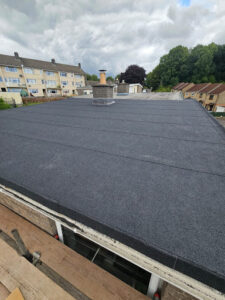
Torch on felt roofing, in case you hadn’t guessed describes the method of application. Do not confuse these modern roofing felts with the older pour and roll system. Great strides continue to be made in bitumen and modified bitumen technology such as SBS or APP, resulting in much better resistance to UV damage and cracking. This type of felt roof comes on rolls and is laid with the aid of a very large blow torch that heats and melts the rear of the felt, melting it onto the roof structure below. Typically it’s applied as a 3 layer system usually consisting of a perforated underlay, a 2mm underlay layer, then thick 4-5mm felt. These layers are all laid in a half lap manner, so all the joints are the furthest away they can be from another joint.
The thickest top layer is often a coloured mineral finish known as a cap sheet, and they are available in a variety of colours, as well as a plain felt finished with a silver solar reflective UV finish. All of these felt layers are also reinforced with strong polyester weave sandwiched in the middle of the felt, giving them incredible strength. In lifespan terms, I don’t know a single roofer that will not be happy to guarantee 10 years, because they know it will last 20, sometimes 30+. In fact we use a company that guarantees for 20 years. Not as bad as you thought is it?
- Cost – By far the cheapest option see our flat roof costs page.
- Suitability – Can be laid to any size of roof, or detail level without problem. Has favourable expansion and contraction properties due to modern bitumen technologies. Not best for heavy and frequent foot fall, especially during the hottest weather in summer months.
- Damage resistance – During hot weather heavy or careless foot traffic may scuff the mineral surface. It is perfectly ok to walk on if you’re careful as long as you don’t have high heels, but no ladders or step ladders without protection between them and the roof.
- Repairability – Repairable by torching a new patch of felt on the top of a damaged section, but it does look a bit patchy. If you have the plain felt and solar finish it’s the easiest to repair.
- Appearance – Beauty is in the eye of the beholder, but a nice mineral finish is pleasant to look at, certainly prettier than a rubber roof. There’s plenty of colours to choose from like green, brown, grey and purple.
- Installation issues – Make sure that any contractor carries full insurance to work with hot flames.
Asphalt roof
Asphalt or mastic asphalt has been around for a very long while now, with good results, and todays asphalt contains modern polymer formulations making it even better. It’s used for all sorts of tasks such as tanking, paving, flooring, damp proofing, and of course roofing, you can see some of the uses here at the Mastic Asphalt Council.
Asphalt can be laid on most rigid structures such as concrete, timber and metal and can be worked around all sorts of details like curves, upstands, slopes and roof lights. Asphalt is heated in an asphalt boiler and laid while still hot onto the roof, trowelled into shape, and cools to form a very hard durable roof. I’ve seen and worked on many asphalt roofs that are at least 40+ years old.
- Cost – Roughly a 20-30% more than a Torch on roof, see our flat roof price page
- Suitability – Can be laid on most roofs of all sizes, extremely tough, but not heavily sloped roofs or flimsy constructions that may flex. Does not require a hot flame during install.
- Damage resistance – Extremely durable, sets hard like an asphalt pavement, withstands all sorts of abuse and footfall.
- Repairability – Easy and cheap to repair with a number of solutions such as liquid, torch on felt, or even laying another roof on top. I have even laid a torch on roof onto an already repaired 40 or 50 year old roof and got another 20-30 years out of it.
- Appearance – I like the look of an asphalt roof, it’s a subtle light grey matt finish with clean lines, what’s not to like.
- Installation issues – Asphalt is heavy, the roof construction must be strong enough to take the weight without movement or cracking occurring. The roof must not suffer from rising moisture underneath as this can cause slow rising bubbles in the surface known as goose eggs in the trade.
EPDM Rubber roof
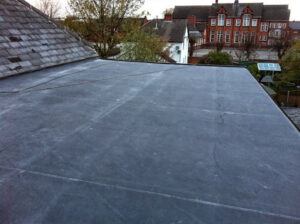
These have stormed onto the UK market after long term success in the USA and other countries. The rubber or E.P.D.M. (Ethylene Propylene Diene Monomer) is commonly made by Firestone, and can often be installed in one complete layer without the need for joins (depending on size) making it an attractive prospect. It is extremely lightweight per square metre, highly elastic and tough, so it lends itself to many roofing situations. Most new domestic rubber roofs are glued down to a new wooden roof substrate, although they can in certain circumstances be laid on top and mechanically fixed or weighed down with ballast. My preference for domestic roofs is a new install with new roof decking as a single ply membrane.
A well installed rubber roof, on the right roof, could last up to 50 years. Some firms will supply a guarantee for 50 years, but this guarantee varies from installer to installer. I always question whether the firm will still be trading in 50 years or if they would honour the guarantee after a few decades have passed, so take this with a pinch of salt.
- Cost – Competitive, expect to pay 20-30% more than a torch on felt roof.
- Suitability – A good choice for green roofs, lightweight, flexible and strong. Does not install well into roofs with complicated details, pipes, curved upstand walls, complicated gulleys or gutters because it becomes full of joints, which can look ugly and leak. Best for nice simple shaped roofs, no naked flames required.
- Damage resistance – A very durable roof, it will resist most forms of abuse apart from heavy impact from pointed objects, but not being cut or vandalised.
- Repairability – It can be repaired very easily with rubber patches, a bit like a bike tyre, although they are not pretty to look at.
- Appearance – For me, this is the achilles heel. It’s a personal thing but a big sheet of black rubber, looks just like a big sheet of black rubber to me. Of course if it’s not visible from a widow, does it matter?
- Installation issues – Unfortunately the apparent ease of install has attracted dodgy roofers who fancy a quick buck. Look for a roofing firm with good trading reviews or a history of fitting other types of flat roof. A large rubber roof will shrink over the years, some say up to 10%, personally I’ve seen it at about 5%. Shrinkage can cause edge details and upstands to pull away from walls if they are not fitted with the correct fitting details, like a russ strip (mechanically fixed edge fixings). A better quality fleece backed EPDM will resist or stop shrinkage, so if you have a large roof, this is well worth a look. A simple roof can be installed in rubber by a competent DIYer.
Fibreglass GRP flat roof
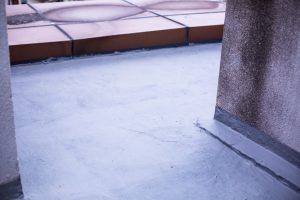
Fibreglass flat roofs have been used in the UK for over 30 years in small numbers, but over the past 10 years interest in GRP (Glass Reinforced Plastic) fibreglass roofs have really taken off. Adoption of fibreglass roofing was hindered in the early days by poor installation practices, and the use of hard boat resins rather than dedicated roofing resins, which led to problems. Now with dedicated roof resins, factory made trims and improved installation knowledge this truly jointless flat roof has rightly taken its place amongst the great flat roofs available.
Most fibreglass roof guarantees are for 20-25 years, and there will be no problems at all if correctly installed. I have personally seen and worked on GRP roofs that are 30 years old, where there was no visible sign of wear or damage apart from a slightly faded colour coat to the finish.
- Cost – Depending on specification this can cost slightly more than a EPDM rubber roof, upwards. There are many options available depending on the final finish and laminate thickness.
- Suitability – Good for green roofs, lightweight, pretty to look at, available in any colour, strong, truly jointless, and will work with all sorts of complicated shapes. Does not in my opinion suit very large roof areas that may be flimsy or suffer excess expansion and contraction. No hot flame required.
- Damage resistance – Withstands frequent footfall, but can be slippy when new without the optional anti slip coating. Practically impervious to all forms of abuse including knife cuts and vandalism.
- Repairability – Repairs can be from a small patch to a layer bonded directly on the top, and almost invisible.
- Appearance – Simply cannot be beaten for looks, all colours available for the final finish, can be cleaned with soap and water.
- Installation issues – The weather has to be totally dry to lay a good fibreglass roof. A quote a lot cheaper than other competitors may indicate a drop in install quality, materials or thickness. Small roofs can be installed by a competent DIYer, in fact I have a complete fibreglass roofing course available on YouTube.
Single Ply Membrane
What is a single ply membrane? In short any roof covering that can make a flat roof waterproof in one layer, unlike roofing felt with its 3 layer system for instance. This can include EPDM rubber and fibreglass talked about above, but commonly, especially in the trade, and in this article it refers to PVC , TPO, TPE and PIB. Unfortunately, to complicate things further these single ply roofs can often be rebranded by large fitting companies into a product name that no longer tells you what membrane they are actually fitting – as a made up example “Rhino roof”.
Firstly these membranes generally share some desirable traits. They are lightweight, flexible, resistant to UV and micro organisms, handle extreme weather and temperature changes, fire resistant and self extinguishing, show good chemical resistance, and can be very environmentally friendly. This has made these types of roof very popular on commercial premises and with architects as you can imagine.
So it must be the best right? Not necessarily for your average homeowner, let’s take a quick look at them in order of what I think is best to worst.
PIB or PolyIsoButylene was introduced in the 1930’s and has the longest track record of all the single ply systems above. It too is 100% recyclable and the lifespan is typical in excess or 30 years, with reports of roofs that are over 50 years old. Like all of the other single ply membranes above it’s easy to install and durable, it is however usually the most costly option. On the downside PIB is not resistant to solvents such a petrol, lacquers, fats and oils, but these are unlikely to be in a domestic setting. You can find out more about PIB here.
PVC membrane or Polyvinyl Chloride has been around since the 1960’s, so it has a good proven track record. Compromising of two thermoplastic layers reinforced with a scrim it is supplied in rolls, and you heat weld the joints like the other systems mentioned here. The typical guarantee is 25 years with a life expectancy of 30 Years+, although it has been reported to last up to 50 years in the right circumstances. On the downside it can be very slick to walk on when wet, and may shrink slightly over time.
TPE or Thermoplastic Polyolefin Elastomer is the ultimate environmentally friendly membrane so far, and is 100% recyclable. Introduced in the 1990’s it’s the newest of the bunch with a reported lifespan of 30 years, but a typical guarantee is for 20. This membrane looks promising, but I don’t have enough real world feedback to give any sensible negative or cautionary advice at the moment.
TPO or Thermoplastic Polyolefin membrane is considered to be more environmentally friendly than PVC, but not quite as good as TPE above. Its been around since the 1980’s, it’s easy to install and has a typical lifespan of about 20 years, with guarantees ranging from 10 to 20 years. TPO is a relatively new roofing material, this means it has, and still is, undergoing changes in the way it is formulated thanks to initial problems with sun damage, expansion wrinkles and shrinkage. What this means is that it is now in it’s 3rd reformulation (and counting), and no one is 100% sure of the final lifespan of a roof installed with TPO.
If you were to summarise these four types of membrane I would say…
- Positives – Lightweight, flexible, pleasant to look at, handles slopes and large areas, durable, repairable, fire resistant, often used with green roofs.
- Negatives – Costs more to install than other flat roof systems in a domestic setting, variable lifespan depending on system, may not suit footfall or complex details, not DIY friendly.
Final thoughts on PVC type membranes. Whilst these type of membranes are often a logical choice in a commercial setting, if you have lots of details like angles, upstands, or gullies, this type of roof, as with EPDM, suddenly get multiple joints in close proximity to overcome changes in roof shape, depth or angle.
More often than not when I have seen single ply roofs like these fail prematurely it has been an abundance of these heat welded joints next to each other that have been the culprit, especially if prone to holding water.
Best flat roof summary
As we have seen, all of these flat roofs have pros and cons whether it’s price, appearance, durability, flexibility, longevity or suitability. There isn’t really such a thing as a bad choice, just a choice that’s right for you. In my personal opinion for every day domestic properties, for me it comes down to felt, fibreglass, and EPDM as the main three, with asphalt a good option with a suitably strong roof, and single ply PVC type membranes, a slightly expensive alternative, where there is a benefit to be had for the customer, like aesthetics or fire retardancy.
Flat roof comparison at a glance
To sum up the difference between flat roofs I have compiled a scoring system out of ten for domestic properties, 10 being the best and 1 the worst. The variation in lifespan depends often on whether the flat roof holds water, the amount of details and joints, as well as the quality of workmanship.
Compare flat roofs – Even though some roofs score low in certain areas, they are within a few points in overall scoring. Should we be surprised? No not really, that’s how these flat roofs became the top choices. Pick a system that suits you, calculate their lifespan against your own, and get at least two like for like quotes. Job done.
Also see…
- Flat roof costs – Current flat roof prices
- Find a recommended roofer – Some tips from a trusted roofer
- New roof – Pitched roof factors that determine price and quality
- Roofing prices – Pitched roof replacement costs, repairs and estimates