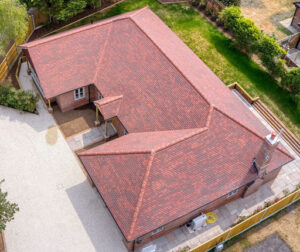
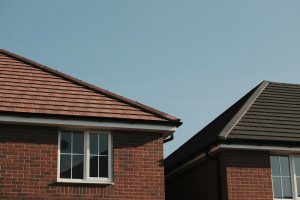
A pitched roof is any roof with two or more sloping sides that meet at a ridge. That slope is what sets it apart from a flat roof, and it is measured as pitch, the ratio of how much the roof rises for every horizontal foot it spans.
Most houses have one. If your roof has a visible ridge running along the top and slopes down on either side, it is a pitched roof. Below, we get into the different types, how pitch is measured, and what it means for your home.
What Is a Pitched Roof?
Once a roof slope exceeds 10 degrees, it’s classified as pitched rather than flat, and that single threshold changes how the roof is built and maintained.
The defining function is simple: rainwater and snow shed naturally via gravity rather than pooling on the surface. That single characteristic is why pitched roofs have been part of the built environment for roughly 5,000 years, starting with early coverings of leaf, bamboo, turf, and stone.
Visually, a pitched roof has a clear triangular profile when viewed from the gable end. The steeper the pitch, the more pronounced the triangle. Structurally, it is constructed with one or more sloping surfaces that meet at a ridge or terminate at an eave.
Pitched roofs are one of the most common roof types in the UK, built to handle the UK’s wind-driven rain and winter snowfall. The country’s wet, temperate climate makes effective water shedding a non-negotiable requirement.
How Is Roof Pitch Measured?
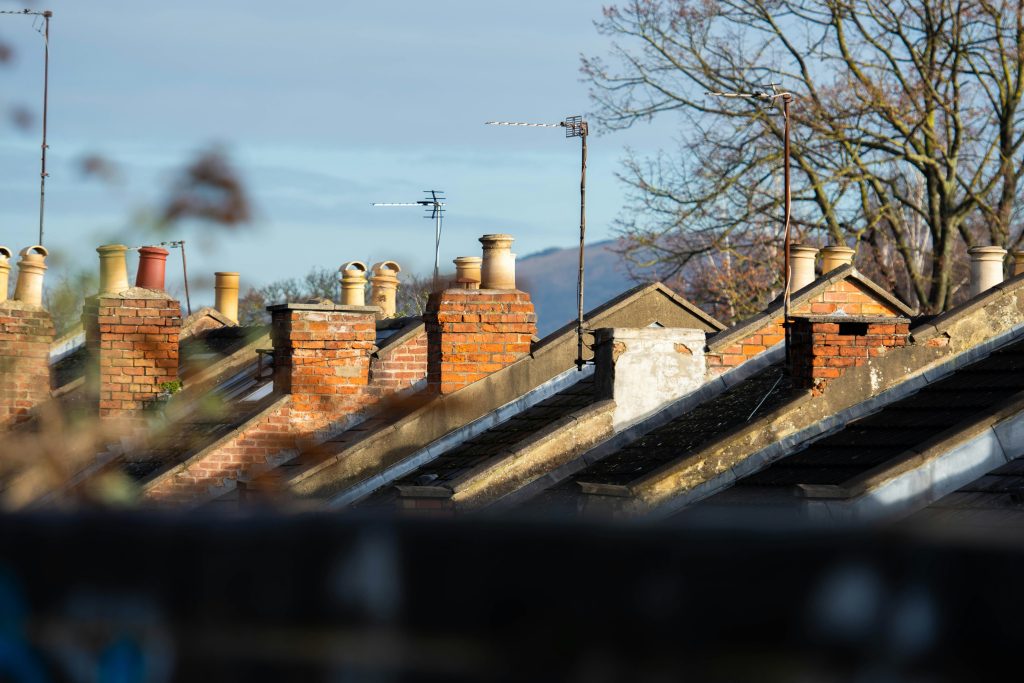
To find a roof’s pitch, divide the vertical rise by the horizontal span. In the UK, it is expressed either as a ratio (e.g. 1:2) or in degrees.
Pitch categories
Pitched roofs fall into three broad categories:
- Low pitch: 10 to 25 degrees. Suited to certain interlocking tiles and metal sheet coverings. Not all tile types perform reliably at these angles.
- Medium pitch: 30 to 40 degrees. The most common range for standard UK housing. Accommodates a wide selection of tiles and slates.
- Steep pitch: Above 40 degrees. Often seen on older properties, churches, and buildings designed to shed heavy snow. Provides generous loft headroom, these are the types of roofs that make a loft conversion easier.
The NCM modelling guide (2013) defines a pitched roof as having a pitch greater than 20 degrees and up to 70 degrees. Above 70 degrees, the surface is classified as a wall for energy calculation purposes.
Why pitch matters
Standard plain clay or concrete tiles typically require a minimum of 35 to 40 degrees. Drop below the manufacturer’s stated minimum and you risk water being driven back under the tiles by wind. Steeper roofs also drain faster but are harder and more dangerous to access for maintenance. A 45-degree roof may require scaffolding for any maintenance,.
The Main Types of Pitched Roof in the UK
Gable (double-pitched) roof
Two slopes meet at a central ridge with vertical gable ends forming the classic triangular profile. This is the most common type in UK residential housing and is well suited to cold and temperate climates. It is straightforward to construct and sheds water efficiently to both sides, leaving generous loft space.
Hip roof
Four sloping sides replace the vertical gable ends with an external angle called a hip. Hip roofs are more resistant to wind and water damage than gable roofs, making them ideal for exposed locations such as coastal areas and parts of Scotland. The trade-off is slightly more complex construction and reduced loft volume.
Mono-pitched (lean-to) roof
A single slope running in one direction. Mono-pitched roofs have been used mostly for extensions, garages, and outbuildings since Victorian times. Where the roof meets the main building at the top or side of its slope, the junction is known as an abutment and must be properly flashed.
Mansard roof
Named after 17th-century French architect Francois Mansart, a mansard features a double slope on all four sides. The steeper lower section maximises usable loft space, making it common on Victorian and Edwardian townhouses. Dormer windows are typically set into the lower slope.
Butterfly roof
Two slopes pitch inward to a central valley rather than outward. This modern architectural style appears in some contemporary UK new-builds. Drainage design is critical because water is directed to the centre of the building.
Key Components of a Pitched Roof Explained
Ridge
The horizontal apex where two slopes meet. It is capped with ridge tiles (now increasingly installed using dry-fix systems rather than traditional mortar) or finished with a timber ridge board internally.
Rafters and purlins
Rafters are the sloping structural timbers forming the skeleton of the roof, running from ridge to eaves. On larger roofs, purlins provide mid-span support, acting as horizontal beams that prevent rafters from sagging over long spans.
Wall plate
A timber member fixed to the top of the masonry wall. The feet of the rafters bear on the wall plate,
Eaves, fascia, and soffit
The eaves are the lower edge of the roof where it overhangs the wall. The fascia board sits vertically at the rafter ends and supports the guttering. The soffit is the horizontal board that closes the gap between the fascia and the wall, protecting the roof structure and often incorporating ventilation openings.
Underlay and battens
The underlay is a secondary waterproofing membrane laid over the rafters beneath the battens. Battens are horizontal timber strips to which tiles or slates are fixed.
Flashing
Lead or aluminium strips that seal junctions at chimneys, abutment walls, and skylights. Failed flashing is a primary source of localised leaks.
Construction methods
The two basic construction methods are the traditional cut roof, where timbers are measured, cut, and assembled on site, and the truss roof, where prefabricated trusses are delivered and crane-lifted into position. Truss roofs dominate modern UK housebuilding.
Common Pitched Roof Materials and Their Lifespans
Concrete interlocking tiles
The most widely used covering in modern UK housing. Concrete tiles are durable, relatively low cost, and available in a broad range of profiles and colours. Typical lifespan: 40 to 60 years.
Clay plain tiles
A traditional material preferred in conservation areas and on period properties. Clay tiles develop a natural patina and can last over a century with proper maintenance. Typical lifespan: 60 to 100 years.
Natural slate
A premium option common across Wales, Scotland, and northern England. Natural slate is exceptionally long-lasting provided fixings are maintained and replaced as needed. Typical lifespan: 80 to 150 years.
Fibre cement slates
An affordable alternative to natural slate, lighter in weight and consistent in appearance. Typical lifespan: 30 to 50 years.
Clay and concrete pantiles
S-profile interlocking tiles particularly common in East Anglia and the East Midlands. Their interlocking design provides good weather resistance at relatively low pitches.
Choosing the right material
As covered in the pitch categories section above, material choice must match the minimum pitch specified by the manufacturer. Industry standards, particularly BS 5534, govern fixing methods and underlay specification to ensure the covering performs reliably. Clay and concrete tiles remain the dominant choice across UK housing due to their colour range and ease of installation.
Why Are Pitched Roofs So Common in the UK?
Around 80% of UK homes have a pitched roof, a direct response to a climate that delivers rain on roughly 150 days a year.
Climate performance
Steeper pitches in northern regions and highland areas are designed to handle snow loading, allowing snow to slide off rather than accumulate. A pitched roof’s angle means that in summer, when the sun is high, less solar radiation strikes the roof surface directly, while in winter, the lower sun angle allows more warmth to reach the building through roof windows and upper glazing.
Usable space
A pitched roof creates loft space for storage or full conversion without extending a building’s footprint, see the more detailed comparison in the Pitched Roof vs Flat Roof section below.
Planning and character
Many local planning authorities require new builds to match the predominantly pitched character of surrounding properties. The Planning Portal provides guidance on when permission is needed for roof alterations.
Maintenance and insurance
Insurers generally view pitched roofs more favourably than flat ones because standing water, the main accelerant of membrane failure, never forms on a sloped surface. Flat roof sections can attract premium loadings or cover restrictions.
Pitched Roof vs Flat Roof: Key Differences
Angle
At anything above 10 degrees a roof is classed as pitched; flat roofs sit between a 1:40 and 1:80 gradient, enough to move water towards drainage outlets but essentially level to the eye.
Drainage
Where a pitched roof sheds water passively across its entire surface, a flat roof depends on precise falls and unbroken membrane integrity. Any failure in a flat roof membrane allows water to pool, which accelerates deterioration.
Lifespan
Industry estimates put a concrete tile pitched roof’s lifespan at around 50 years, though materials range from 30 years (fibre cement) to over 150 years (natural slate). A quality flat roof membrane (such as EPDM) typically lasts around 30 years before replacement is needed.
Cost
Typical UK costs for a pitched roof range from £30 to £50 per square metre for concrete tiles on a simple gable, rising to £80 to £120 per square metre for natural slate on a complex hip roof. The upfront cost is higher than a flat roof, but the longer lifespan and lower maintenance requirements often make it cheaper over the building’s lifetime.
Usable space
The loft space under a pitched roof can store belongings or convert into a bedroom; a flat roof might support a terrace, but that requires specialist waterproofing, structural checks, and often planning permission.
Planning considerations
Replacing a flat roof with a pitched roof usually requires planning permission, since it changes the building’s height and appearance. The long-term benefits in drainage and lifespan often justify the application.
UK Building Regulations That Apply to Pitched Roofs
Several parts of the Building Regulations (England and Wales) apply directly to pitched roof work.
| Regulation | Key Requirement |
|---|---|
| Part A: Structure | Roof must support its own dead weight plus imposed loads from snow, wind, and foot traffic during maintenance. |
| Part C: Moisture | The roof assembly must prevent moisture penetrating to the interior, covering the primary covering and underlay as well as junction and penetration detailing. |
| Part L: Energy | New builds and full re-covers must meet a U-value of 0.16 W/m²K for the roof element. Approved Document L sets out compliance routes. |
| Part F: Ventilation | Roof spaces must be adequately ventilated to prevent condensation and timber decay, especially in cold roof constructions. |
| Part O: Overheating | Applies to new residential builds with roof windows or solar-facing glazing; requires designers to demonstrate overheating risk has been addressed. |
| BS 5534 | Governs fixing methods for slating and tiling, batten specification, and underlay performance. Dry-fix systems for ridge and hip tiles are now recommended. |
Planning permission
Like-for-like covering replacements are generally permitted development. Changing the roof shape, adding dormers, or altering the ridge height typically requires full planning permission. Check with your local authority or the Planning Portal before starting work.
Common Pitched Roof Problems to Watch For
Cracked, slipped, or missing tiles
Even one displaced tile can allow water ingress that damages timbers and insulation, eventually reaching the ceilings below. High winds and frost are common causes, along with foot traffic from aerial installers.
Failed ridge or hip mortar
Traditional mortar bedding on ridge and hip tiles deteriorates over time, allowing tiles to loosen and lift. BS 5534 now recommends dry-fix systems as the standard approach for new installations and replacements.
Flashing failure
Lead or aluminium flashing at chimney stacks, abutment walls, and skylights is a primary cause of localised leaks. Thermal movement, corrosion, and poor original installation all contribute to failure.
Blocked or damaged gutters
When gutters overflow, water can be driven back under the eaves, causing rot to fascia boards and damp to the wall below. Regular clearing, especially in autumn, prevents this.
Condensation and poor ventilation
In cold roof constructions, warm moist air rising from the living space can condense in the roof void. Over time this causes timber decay and mould growth. A properly ventilated roof cavity helps evacuate moisture before it accumulates.
Sagging roof structure
Visible sagging along the ridge or rafter line indicates potential rafter or purlin failure, often from long-term moisture damage or undersized timbers. This requires urgent professional assessment.
Early warning signs
Watch for damp patches on upstairs ceilings, daylight visible through the roof covering when you look up in the loft, granules from degrading tiles collecting in gutters, and heavy moss or lichen growth that retains moisture against the roof surface. Catching these early saves money and prevents structural damage.
If you’re having problems with your pitched roof, Fix My Roof will be able to help you getting multiple quotes from approved roofers. Simply type in your postcode here, and get matched with roofers local to you have a history of serving customers well.