A pitched roof is any roof with two or more sloping sides that meet at a ridge. The slope is what separates it from a flat roof, and it is usually described by its pitch: how far the roof rises compared with the horizontal distance it covers.
Most UK homes have a pitched roof. If yours has a visible ridge along the top and slopes down on either side, that is the structure you are looking at. This guide covers the main pitched roof types, how pitch is measured, and why it matters for materials, maintenance, and cost.
What Is a Pitched Roof?
A roof is generally treated as pitched once its slope exceeds 10 degrees. That may sound like a minor technical detail, but it affects the roof’s structure, the materials that can be used, and the way the roof handles British weather.
The main job is simple: a pitched roof helps rainwater and snow run off rather than sit on the surface. That is why pitched roofs have been used for thousands of years, from early coverings made from leaves, bamboo, turf, and stone to the tiled and slated roofs that define UK housing today.
From the gable end, a pitched roof has a clear triangular outline. The steeper the pitch, the sharper that triangle. Structurally, it is built from one or more sloping roof planes that either meet at a ridge or finish at the eaves.
Pitched roofs suit British weather. When rain is coming in sideways on a January afternoon, getting water off the roof quickly is not a bonus feature. It is the job.
How Is Roof Pitch Measured?
Roof pitch compares the vertical rise of the roof with its horizontal span. In the UK, pitch is normally given as a ratio, such as 1:2, or as an angle in degrees.
Pitched roofs usually fall into one of three groups:
- Low pitch: 10 to 25 degrees. These roofs need coverings designed to work at shallower angles, such as certain interlocking tiles or metal sheet systems. Not every tile is suitable.
- Medium pitch: 30 to 40 degrees. The most common range for standard UK homes, and compatible with a wide choice of roof tiles and slates.
- Steep pitch: Above 40 degrees. Often found on older buildings, churches, and properties built to shed heavy snow. A steeper pitch can also create more loft headroom, useful if a conversion is on the cards.
The NCM modelling guide defines a pitched roof as one with a pitch greater than 20 degrees and up to 70 degrees. Above 70 degrees, the surface is treated as a wall for energy calculation purposes.
Why pitch matters
Pitch affects drainage, material choice, maintenance access, and cost. Standard plain clay or concrete tiles usually need a minimum pitch of around 35 to 40 degrees, depending on the manufacturer. Install tiles below their recommended minimum, and wind-driven rain can be pushed underneath them.
Steeper roofs shed water faster, but they are harder to work on. The same slipped tile on a 45-degree roof may need more access equipment than on a shallower one. Same repair. Less friendly angle. Different quote.
The Main Types of Pitched Roof in the UK
Gable (double-pitched) roof
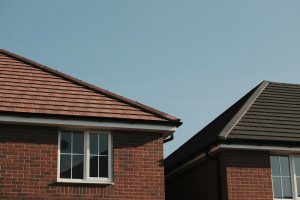
A gable roof, sometimes called a double-pitched or dual-pitched roof, has two sloping sides that meet at a central ridge, with vertical ends forming the familiar triangle most people picture when they think of a house roof.
This is the most common pitched roof style on UK homes. It is relatively simple to build, sheds water well on both sides, and usually provides useful loft space.
Hip roof
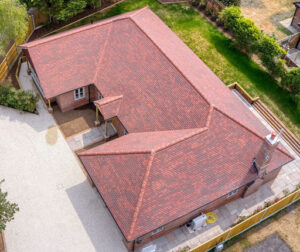
A hip roof has four sloping sides rather than two. Instead of vertical gable ends, the roof angles on all sides, with the outside angles known as hips.
Hip roofs perform well in windy and exposed locations, which is why they are useful on coastal properties and in parts of Scotland. The trade-off is complexity. They are more expensive to build than a simple gable and often less generous with usable loft space.
Mono-pitched (lean-to) roof
A mono-pitched roof has one slope running in a single direction. It is common on extensions, garages, sheds, and outbuildings.
Where a mono-pitched roof meets the main building, the junction is called an abutment. This area needs proper flashing. A tidy-looking join that lets rain through is still a problem, just a neater one.
Mansard roof
A mansard roof has two slopes on each side. The lower slope is steep; the upper slope is much shallower.
The style is named after 17th-century French architect François Mansart and is often seen on Victorian and Edwardian townhouses. Its main advantage is usable space. The steep lower section creates a more practical upper floor or loft area, often with dormer windows built in.
Butterfly roof
A butterfly roof has two slopes that fall inward towards a central valley rather than outward. It is more common on contemporary new-builds than on traditional homes.
It can look striking, but drainage has to be carefully designed because water is being directed into the middle of the building. If the central valley is not built and maintained properly, trouble has a very clear route in.
Key Components of a Pitched Roof Explained
Ridge
The ridge is the horizontal line at the top of the roof where two slopes meet. On the outside, it is finished with ridge tiles, now often fitted with dry-fix systems rather than traditional mortar. Inside, it may be supported by a timber ridge board.
Rafters and purlins
Rafters are the sloping structural timbers that give the roof its shape, running from the ridge down to the eaves.
Purlins are horizontal beams that support the rafters partway along their length on larger roofs. Without enough support, long rafters can sag. Roofs do not always fail dramatically. Sometimes they just move slowly and quietly until the repair bill gets interesting.
Wall plate
The wall plate is a timber member fixed along the top of the masonry wall. The lower ends of the rafters sit on it, transferring the roof load into the walls below. Invisible from the street, but doing important structural work.
Eaves, fascia, and soffit
The eaves are the lower edge of the roof where it overhangs the wall.
The fascia is the vertical board fixed to the rafter ends, often supporting the guttering.
The soffit is the horizontal board underneath, closing the gap between the fascia and the wall. Some soffits include vents to help air move through the roof space.
Underlay and battens
Underlay is the secondary waterproofing layer beneath the roof covering, protecting the structure if rain gets past the tiles or slates.
Battens are horizontal timber strips fixed above the underlay to which tiles or slates are fixed. If battens rot or underlay fails, the roof can look fine from the street while the real damage carries on underneath.
Flashing
Flashing seals junctions around chimneys, abutment walls, skylights, and other vulnerable points. Lead and aluminium are the common materials. Failed flashing is one of the most frequent causes of localised roof leaks.
Construction methods
The two main approaches are cut roofs and truss roofs.
A traditional cut roof is measured, cut, and assembled on site. A truss roof uses prefabricated triangular frames delivered and lifted into position. Truss roofs are now common in modern UK housebuilding because they are quick to install, consistent, and efficient.
Common Pitched Roof Materials and Their Lifespans
Concrete interlocking tiles
One of the most common roof coverings on modern UK homes, concrete interlocking tiles are durable, relatively affordable, and available in a wide range of profiles and colours.
Typical lifespan: 40 to 60 years.
Clay plain tiles
Clay plain tiles are a traditional choice, often used on older properties and homes in conservation areas. They weather naturally and last well when fitted correctly.
Typical lifespan: 60 to 100 years.
Natural slate
Natural slate is a premium material, common across Wales, Scotland, and northern England. It is highly durable, though installation quality and fixing specification still matter.
Typical lifespan: 80 to 150 years.
Fibre cement slates
Fibre cement slates are lighter and cheaper than natural slate, with a neat, consistent appearance. They are often used where natural slate is too expensive or too heavy for the structure.
Typical lifespan: 30 to 50 years.
Clay and concrete pantiles
Clay and concrete pantiles have an S-shaped interlocking profile and are particularly common in East Anglia and the East Midlands. They offer good weather resistance at relatively low pitches.
Choosing the right material
The best material depends on roof pitch, property style, exposure, budget, and any planning restrictions. Manufacturer minimum pitch requirements should always be followed, and BS 5534 sets the standard for fixing methods, underlay specification, and batten quality.
Why Are Pitched Roofs So Common in the UK?
Around 80% of UK homes have a pitched roof, largely because regular rainfall, wind, and occasional winter snow make a sloping roof the practical default.
A pitched roof moves water away from the building quickly. In northern regions and upland areas, steeper pitches also help shed snow rather than let it accumulate.
Usable space
A pitched roof creates loft space that can be used for storage, insulation, services, or a full conversion if height and structure allow.
Planning and character
Local planning authorities often expect roof work to fit the surrounding area. Roof shape, height, and material can all affect the character of a street, particularly in conservation areas or on listed buildings. The Planning Portal explains when permission may be needed for roof alterations.
Maintenance and insurance
Insurers often view pitched roofs more favourably than flat roofs because standing water is less of a concern. That does not mean pitched roofs look after themselves. Slipped tiles, failed flashing, blocked gutters, and poor ventilation all need attention.
Pitched Roof vs Flat Roof: Key Differences
Angle
A pitched roof has an obvious slope. A flat roof still needs a slight fall, usually around 1:40 to 1:80 gradient. That difference affects drainage, lifespan, materials, maintenance, and planning.
Drainage
A pitched roof sheds water across the covering and into the guttering. A flat roof depends on carefully formed falls and a continuous waterproof membrane. If that membrane fails, water can pool and accelerate deterioration.
Lifespan
A concrete tiled pitched roof often lasts around 50 years; natural slate considerably longer. A good flat roof membrane such as EPDM can last around 30 years.
Cost
Typical UK costs for a pitched roof range from £30 to £50 per square metre for concrete tiles on a simple gable, rising to £80 to £120 per square metre for natural slate on a complex hip roof. The upfront cost is usually higher than a flat roof, but the longer lifespan and lower maintenance needs can make a pitched roof cheaper over the building’s lifetime. Cheapest on day one is not always cheapest by year twenty.
Usable space
A pitched roof can create loft storage or headroom for a bedroom conversion. A flat roof may support a terrace, but that needs specialist waterproofing, structural checks, and often planning permission.
Planning considerations
Replacing a flat roof with a pitched roof usually needs planning permission because it changes the building’s height and appearance. The long-term benefits in drainage and lifespan may still justify the application.
UK Building Regulations That Apply to Pitched Roofs
| Regulation | Key Requirement |
|---|---|
| Part A: Structure | The roof must support its own dead weight plus imposed loads from snow, wind, and maintenance foot traffic. |
| Part C: Moisture | The roof assembly must prevent moisture from reaching the inside, including the primary covering, underlay, junctions, and penetrations. |
| Part L: Energy | New builds and full re-covers must meet a U-value of 0.16 W/m²K for the roof element. Approved Document L sets out compliance routes. |
| Part F: Ventilation | Roof spaces must be properly ventilated to reduce condensation and timber decay, particularly in cold roof constructions. |
| Part O: Overheating | Applies to new residential builds with roof windows or solar-facing glazing; designers must show overheating risk has been considered. |
| BS 5534 | Covers fixing methods for slating and tiling, batten specification, and underlay performance. Dry-fix systems for ridge and hip tiles are now recommended. |
Like-for-like roof covering replacements are usually permitted development. Changing the roof shape, adding dormers, or altering the ridge height normally requires full planning permission. Check with your local authority or the Planning Portal before starting work.
Common Pitched Roof Problems to Watch For
Cracked, slipped, or missing tiles
Even one missing tile can let water into the roof, damaging timbers and insulation before eventually reaching the ceilings below. High winds, frost, and foot traffic from aerial installers are common causes.
Failed ridge or hip mortar
Traditional mortar bedding on ridge and hip tiles breaks down over time, allowing tiles to loosen or lift. BS 5534 now recommends dry-fix systems as the standard for new installations and replacements.
Flashing failure
Lead or aluminium flashing around chimney stacks, abutment walls, and skylights is a common cause of localised leaks. Thermal movement, corrosion, and poor original installation can all lead to failure.
Blocked or damaged gutters
When gutters overflow, water can be pushed back under the eaves, causing rot to fascia boards and damp to the wall below. Regular clearing, particularly in autumn, helps prevent this.
Condensation and poor ventilation
In cold roof constructions, warm moist air from the living space can condense in the roof void. Over time, that causes timber decay and mould growth. Proper ventilation lets moisture escape before it builds up.
Sagging roof structure
Visible sagging along the ridge or rafter line can indicate rafter or purlin failure, often from long-term moisture damage or undersized timbers. This needs urgent professional assessment.
Early warning signs
Damp patches on upstairs ceilings, daylight visible through the roof covering from the loft, tile granules collecting in the gutters, and heavy moss or lichen holding moisture against the roof surface are all worth acting on. Catching these signs early can save money and help avoid structural damage.